SEO for AI
Help potential customers find and understand your business when they search with AI. We review how your business appears in AI answers and improve the content, structure and information that support an accurate picture of what you offer.
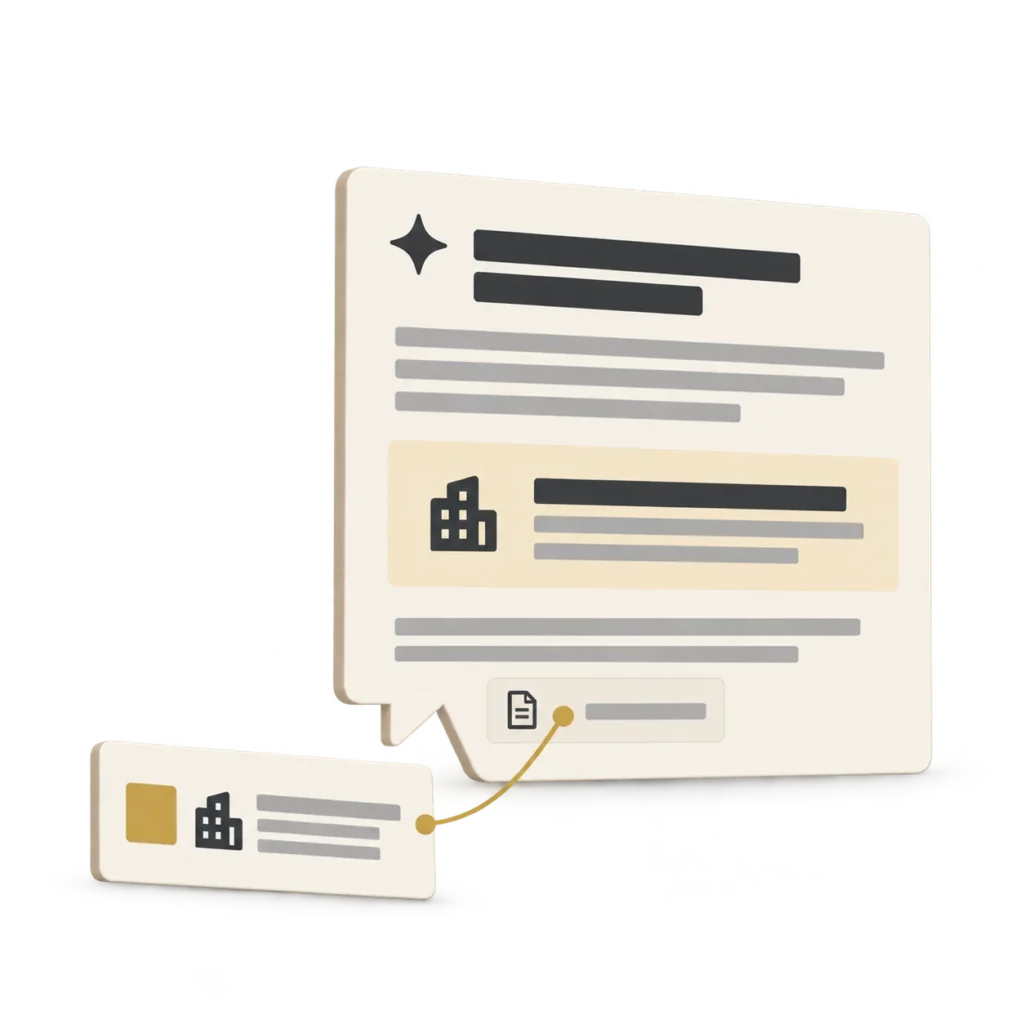
What does AI say about your business?
Someone comparing providers might ask an AI assistant who can help with a particular problem, how the options differ or what to consider before buying. Your website should give them something useful to work with when they reach it.
That starts with specific information. Who is your service for? What does it include? Where does your experience come from? What would make you a suitable choice?
We approach AI search optimization by looking at those questions alongside the information available about your business. We can then work on the gaps that matter, whether that’s an unclear service page, outdated business details or useful expertise that never made it onto your website.
What we look at
How your business appears in relevant answers
We review a focused set of questions based on your services, customers and buying decisions. These can include searches about your own brand and broader questions where a customer is comparing solutions.
We look at whether your business appears, how it’s described and which sources are cited. If another provider is mentioned, we examine the information supporting that answer. This gives us examples to investigate and a starting point for later comparison.
Content that helps someone make a decision
A page can describe a service without answering the questions a buyer actually has. We review your service pages and supporting content for missing explanations, vague claims and information that’s difficult to find.
Recommendations might include a more direct answer, a useful comparison, a clearer explanation of your process or evidence drawn from your own work. If you have original research, practical examples or specialist knowledge, we help you identify where it would be useful. Any claims need to reflect what you can genuinely support.
A consistent picture of your business
We compare the key details on your own website with relevant profiles, directory listings and other websites that describe your business. That includes your business name, services, people and the markets you serve.
For local businesses, your Google Business Profile and service area may be part of that review. The aim is to identify inaccurate or outdated information and agree on useful corrections, while keeping your positioning recognizable across different places.
Technical access and structured information
Useful content needs to be accessible. We check for technical barriers affecting the agreed pages, including crawler restrictions and important information that may be difficult to retrieve.
Where relevant, we also review structured data, or schema markup, against the visible content. Recommendations should describe your business accurately and support a sound website structure. Any development work can be coordinated with your developer or a development partner.
Build on the SEO work that already makes sense
Your existing SEO work still matters. Google says its usual SEO best practices apply to AI Overviews and AI Mode; there’s no special AI markup required for inclusion.
My approach adds a closer look at the answers people receive: how your business is described, which pages or sources are cited, and what information is missing. We use that alongside your existing content strategy and search performance to decide what to improve.
There’s little value in publishing another page if a better explanation on an existing service page would do the job.
How we work together
Start with your customers and priorities
We agree on the services, markets and customer questions that matter to your business. Existing keyword research, customer enquiries and SEO reports can help shape the review. You don’t need a technical background or a prepared list of AI prompts to get started.
Review the evidence and set out the work
We review the agreed questions and pages, then explain what we found and why it matters. You get a prioritized set of recommendations, with examples and a distinction between what we observed and what still needs testing.
Make the agreed improvements
We decide which changes to work on and who will handle them. That might involve editing existing content, improving service information, correcting business profiles or addressing technical issues. New copy, development and any work on external mentions are scoped before they begin.
Check progress in context
We revisit the agreed questions and look at the available evidence. That can include changes in how your business is described, citations to your pages and identifiable referral traffic from AI search.
Where tracking is available, we also look at what visitors do afterwards, including enquiries. A brand mention is useful to record, but it needs context before we treat it as a business result.
A focused review or support with the changes
We can start with a review of your current position and priorities, or agree on a project that also includes improvements and follow-up checks.
We’ll recommend a scope based on your website, services and the questions we need to investigate. Pricing is by custom quote, with VAT added. If you already have an SEO audit or content plan, we’ll use the relevant work rather than start again automatically.
Frequently asked questions
Is SEO for AI the same as GEO, AEO or LLMO?
These terms overlap. Generative engine optimization, answer engine optimization and large language model optimization are used to describe different aspects of visibility in AI-generated answers. Providers use them differently, so the actual work matters more than the label. Here, the focus is your website content, business information, technical access and how your business appears in relevant answers.
Can you get my business recommended by ChatGPT?
We can work on the information and technical conditions that support discovery and accurate representation. We can’t control whether an AI system recommends your business or guarantee a citation. The review will show what we observed, and the recommendations will explain what each change is intended to improve.
How do you measure AI visibility?
We use a defined set of relevant questions and record the platform, date, answer and cited sources so comparisons have context. Answers can vary between runs and users, so a single result is a snapshot. Where available, Google Analytics can help identify referral visits, while Google Search Console provides broader search-performance context. These measures won’t capture every mention or every customer influenced by an AI answer.
Does this mean letting AI companies train on my content?
Search access and model training can have separate controls. For example, OpenAI distinguishes its search crawler from its training crawler. We review the relevant settings and explain the options before recommending changes, based on which systems you want to allow access to your content.
Do I need to publish lots of new content?
Often, the first useful step is improving what you already have. A service page may need a better explanation, stronger supporting evidence or answers to questions customers already ask. New content makes sense when it fills a real gap. We’ll agree on that before adding it to the project.
Let’s see where your business stands
Send us your website and tell us which services you want to be found for. If you’ve seen an AI answer that describes your business incorrectly, or leaves you with questions, send that too. It’s a useful place to start.
See our Privacy Policy for how we handle your details.